It’s a sight that defines Bali: tiny, hand-woven baskets of colorful flowers placed carefully on sidewalks, in doorways, and on dashboards. If you’ve ever wondered, what is a Canang Sari and what its purpose is, this guide will explain the beautiful meaning behind these daily Balinese offerings.
The Heart of the Offering: What “Canang Sari” Means
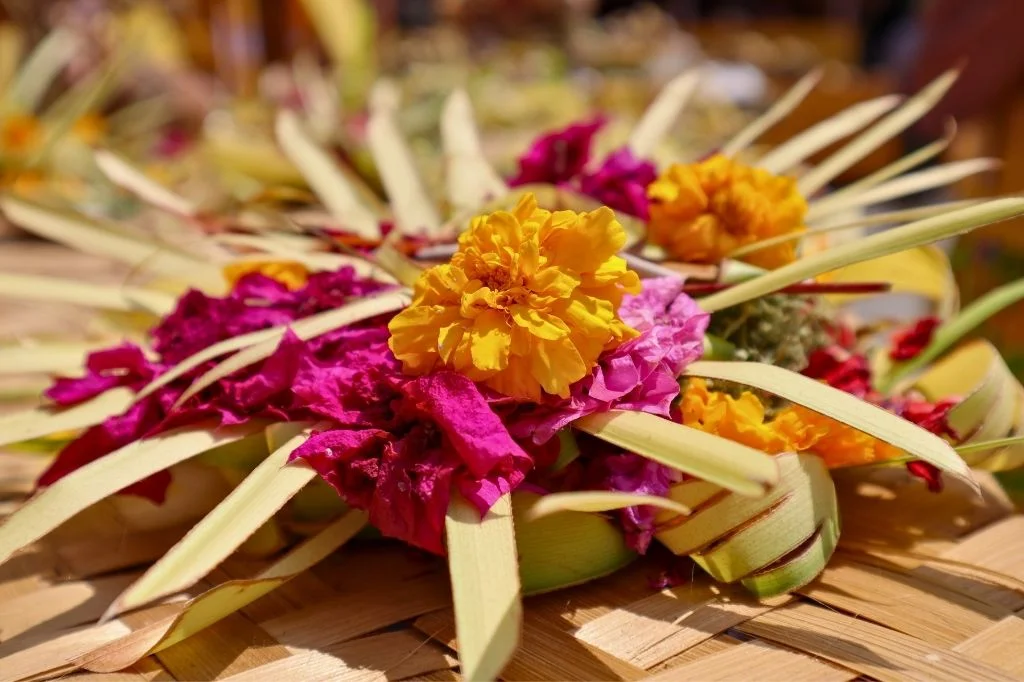
To understand the offering, it helps to understand its name. In the Balinese language, Canang refers to the small palm-leaf tray, and Sari means essence or core. Together, Canang Sari is a daily offering that represents gratitude to the supreme god of Balinese Hinduism, Sang Hyang Widhi Wasa. It is a gesture of self-sacrifice and thanks, a way to maintain balance and peace between the realms of gods, humans, and the natural world.
Deconstructing the Canang Sari: A Symphony of Symbols
Every single element within these Balinese offerings is intentional and rich with meaning. It’s a beautiful symphony of symbols that represents the entire universe in a tiny package.
The Base (Ceper)
The square base, called a ceper, is skillfully woven from young coconut leaves. This base represents the earth (pertiwi) and the physical world itself.
The Core Ingredients (Porosan)
At the heart of most Canang Sari, you might find a small packet containing three ingredients: a betel leaf, a piece of lime (calcium carbonate), and a gambir nut. These three items symbolize the Hindu trinity, or Trimurti: Shiva (lime), Vishnu (betel leaf), and Brahma (gambir).
The Flowers: A Compass of Color
The flowers are the most visually striking component, and their placement is a compass of prayer. Each color is symbolic, pointing to a different direction and honouring a different deity:
- White flowers point to the East, representing the god Iswara.
- Red flowers point to the South, representing the god Brahma.
- Yellow flowers point to the West, representing the god Mahadeva.
- Blue or Green flowers point to the North, representing the god Vishnu.
The “Sari” (The Essence)
To complete the offering, other elements are added. A small cracker, piece of candy, or a coin might be included to represent worldly goods. Finally, a stick of burning incense (dupa) is lit. Its smoke is what carries the sari, or the essence of the offering, up to the heavens.
A Living Tradition: Where and Why You See Them
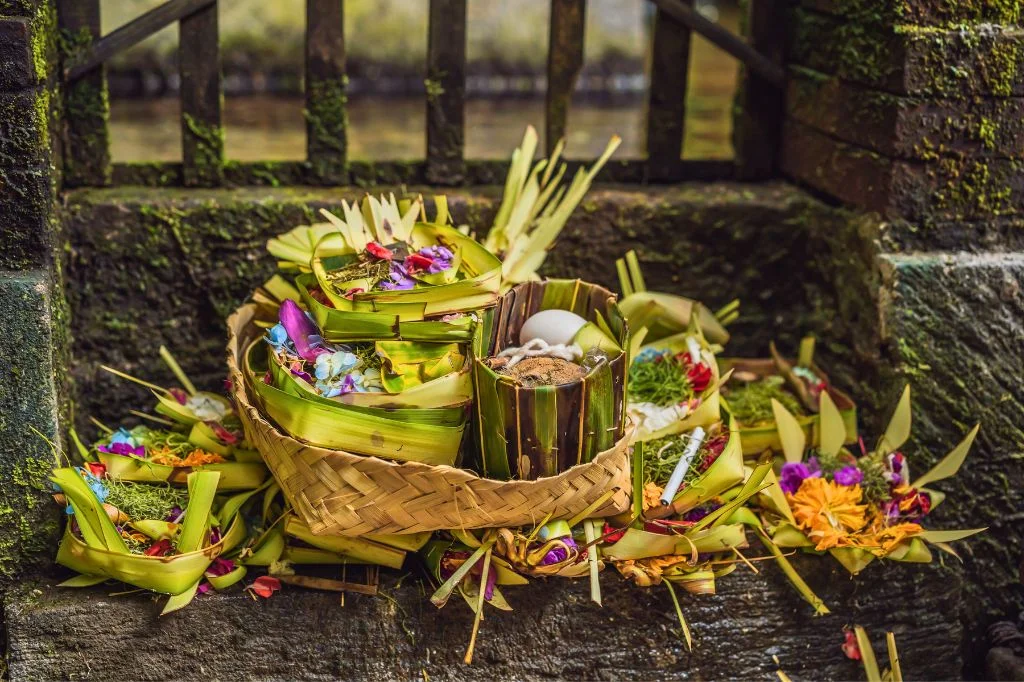
Making and presenting Canang Sari is a daily ritual for Balinese Hindus, not something reserved for special ceremonies. You will see them placed in significant locations every morning: on household shrines, at the entrance to businesses to ask for prosperity, in temples, and even at crossroads or on bridges, which are sometimes seen as spiritually potent or dangerous areas. This daily act of devotion is a fundamental part of Balinese temple etiquette and life.
How to Be Respectful as a Visitor
As you walk through Bali, there is one crucial rule to remember: do not intentionally step on or over a Canang Sari. These are sacred offerings. Even after the incense has burned out, the offering is still considered to be serving its purpose. Locals understand that accidents can happen on a busy sidewalk, but making a conscious effort to walk around them is a simple yet profound sign of respect.
Final Thoughts: More Than Just Flowers
Now that you know what is a Canang Sari, you can see it not as a decoration, but as a beautiful, tangible expression of daily gratitude. It is a constant reminder of the unseen forces that shape life and a commitment to maintaining harmony. Each tiny basket is a window into the soul of Bali and a testament to the Balinese philosophy of balance.
Frequently Asked Questions about Canang Sari
Who makes the Canang Sari?
Traditionally, it’s the daily duty of Balinese women to make fresh Canang Sari for their households every morning.
Is it okay to take a picture of a Canang Sari?
Yes, it is perfectly fine to take photos. Just be mindful and respectful, especially if someone is in the process of praying or placing the offering.
What happens to the offerings at the end of the day?
They are seen as having served their spiritual purpose once the “sari” or essence has been offered. At the end of the day, they are swept up and disposed of, and a new one is made the next morning.
Why is there sometimes a cracker or candy on it?
These small food items, along with sometimes a coin or cigarette, are included to represent a tangible, worldly offering (artha), completing the spiritual gesture.
Do the flowers have to be specific types?
While certain flowers are preferred for their symbolism (like frangipani or marigolds), the key is the color representing the direction and the deity. People use the flowers that are available to them.
What does the incense smoke symbolize?
The smoke from the burning incense (dupa) is believed to carry the “sari” or the essence of the offering up to the heavens for the gods.
Is there a larger version of this offering?
Yes, Canang Sari is the simplest daily offering. For temple ceremonies, you will see much larger and more elaborate offerings called “banten.”
What if I accidentally step on one?
While it’s best to be mindful, locals understand that accidents happen, especially with so many offerings on the sidewalks. Simply be aware and try not to do it again; no one will get angry at you for an honest mistake.
Can I try making one myself?
Yes! Many cultural workshops in places like Ubud offer classes on how to make a Canang Sari. It’s a wonderful way to connect with and appreciate the local culture.
Is the Canang Sari only a Hindu tradition?
In Indonesia, it is specific to the form of Hinduism practiced in Bali, known as Agama Hindu Dharma. It’s a unique and iconic part of Balinese culture.